PROPOSED PROJECT
Brand Character Production
Create a recognizable brand character for your audience, with a design guide, reusable files, and a first batch of content about your products and ideas.
Recognizable in a glance. Consistent in the next scene.
Three proposed pose families
Six scoped launch pieces
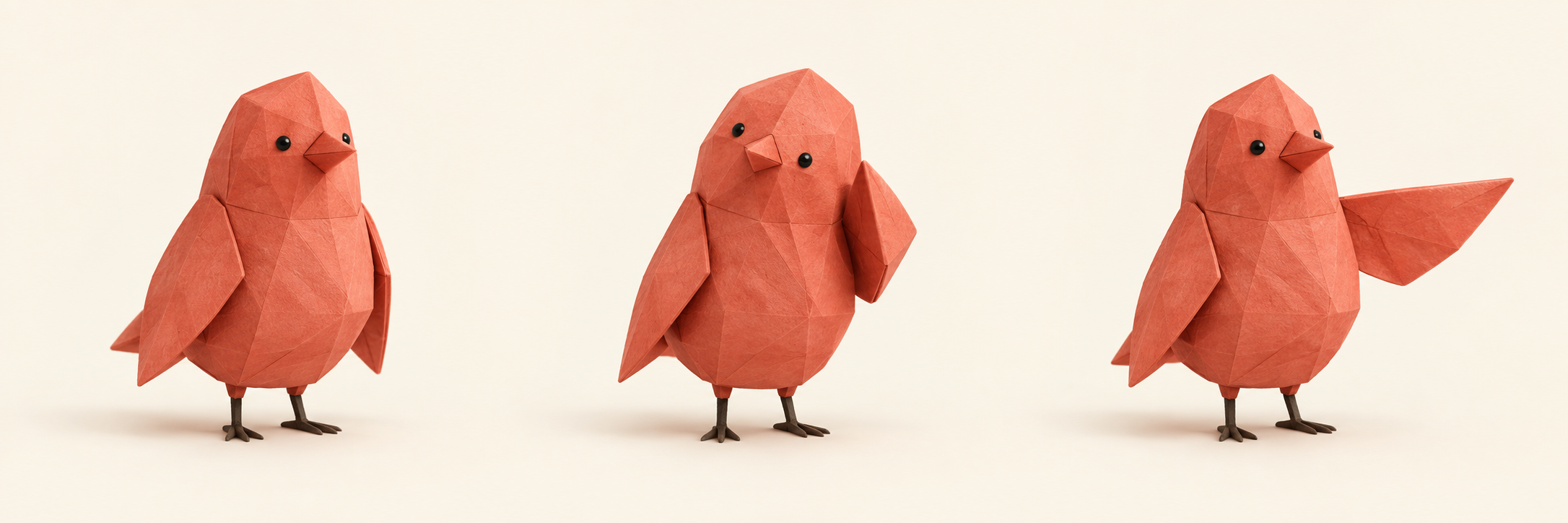
A neutral, approachable introduction.
A head tilt and restrained raised wing.
An open wing gives the scene a direction.
The project in practice.
Create a recognizable brand character for your audience, with a design guide, reusable files, and a first batch of content about your products and ideas.
WHAT IS USUALLY DONE
A mascot is often delivered as a single illustration. Each new pose or scene then becomes another design task, and appearances drift when different teams make the assets.
WHAT SOVRUN CAN DO FOR YOU
Sovrun would design a character with a defined role for your audience, such as explaining your products and ideas or guiding an event experience. An approved expression and pose library would anchor a reference-driven image workflow. A first release could include a character guide and six short content pieces built from approved situations.
Design what stays fixed.
Direct what can change.
This fictional guide character uses a coral paper body, a short beak, small dark eyes, and clean folded wings. Poses can change, but the production team needs a consistent silhouette, scale, and paper treatment across every output.
One character identity.
- Body + wings
- Coral folded paper
- Face
- Small dark eyes + short beak
- Material
- Matte, visible paper folds
- Approval reference
- Illustrator-owned model sheet
Different jobs in the scene.
- Welcome
- Introduce the message
- Listen
- Invite a question
- Guide
- Indicate the next action
- Avoid
- Extra limbs or changing costume
Test current reference-driven image and motion tools against the same model sheet. Keep the strongest controllable route, then redraw or composite identity errors and animate from approved poses. A new tool is useful only if the character survives the next revision.
A character your team
can keep making things with.
The first release includes the model sheet, reusable production guidance, and six scoped content pieces. These boards define that delivery; they are not finished videos.
Keep the recognizable details.
A job for every pose.
- Welcome
- Opening card + Event welcome
- Listen
- Question prompt + Support handoff
- Guide
- Feature introduction + Next-step reminder
Ready for the next scene.
- Source art
- Editable illustrator files
- Pose references
- Approved views + expressions
- Scene checks
- Identity, proportion, material
- Motion output
- Final review before release
How we’d make it happen.
Design
Establish the character’s silhouette, proportions, behavior, and role.
Test
Check whether the production workflow reproduces the same character across different scenes.
Produce
Correct the selected outputs and package source assets for future campaigns.
Where AI helps
AI explores poses and backgrounds using the character references. Selected results are redrawn, composited, or animated to preserve identity.
What people approve
An illustrator owns the model sheet and corrects inconsistent anatomy, costume details, and expressions. Writers approve the character’s voice.
What we’d need to start
- Brand personality and a brief on your audience
- Ownership or licensing of character references
- Approved content topics about your products and ideas
How we’d test it
Compare the content against the model sheet and check whether another studio team can reproduce the approved look.
This is a proposed project, not completed client work. The visuals and numbers show example outputs, not measured results.


 Work,